Shaadi - Weddings
Its been quite a few years since I got married...I remember enjoying my wedding and not having to worry about anything at all--despite a guestlist of over 500 people and a 5 day wedding in a foreign country (India). All this was possible due to my wedding planner (who is also my sister). She has just started a blog...check it out if you have decided to tie the knot! (Miss Indian Bride -- all about Indian weddings)
Saturday, May 22, 2010


Saturday, April 17, 2010
Human Rights Watch
Human Rights Watch(HRW) is a well known NGO that claims that "The hallmark and pride of Human Rights Watch is the even-handedness and accuracy of our reporting". This is not reflected in its agenda regarding Israel and the Arab-Israeli conflict nor is it reflected in its agenda regarding India or Hinduism.
Human Rights Watch is a New York based NGO that is funded mostly by institutions, foundations, and large individual donors. While 75% of HRW’s funds come from America, their funders include rich members of the Saudi family who are linked with the Saudi Arabian government.
The NGO is known for bias as well as false reporting. For example, in 2006, HRW put out a report saying that Israel took potshots at Lebanese civilians waving white flags. Israel later produced documents and videotapes showing that the "civilians" waving white flags were Hezbollah soldiers launching missiles. But as of 2008 the report is still being cited in academic dissertations under headings like "8.1.1 Possible war crimes committed by Israel." Similarly, in the report “Compounding Injustice,” HRW state “Forensic evidence suggesting that the train was set on fire from the inside, and not by the Muslim mob outside, has not found its way into the investigation.” However, this is in direct conflict with eyewitness reports (pg. 14 of the Tewatia report).
A closer examination reveals extensive and systematic bias exists in HRW reports on human rights and communal violence in India. The most glaring defect of HRW reports is the lack of concern for the rights and lives of Hindus. Incidents of communal violence in which both Hindus and Muslims were involved in and share the blame for are portrayed as one-sided attacks by Hindus against “innocent minorities.” Human rights abuses against Hindus are ignored or downplayed compared to attacks against other religious groups. The 1999 report on attacks on Christians goes a step further as it demonstrates hostility to the Hindu religion itself. Rather than attempting to provide an objective assessment of communal violence and human rights practices in India, HRW's reports are written with the intent of waging political warfare against the BJP and the Sangh Parivar. HRW's reports on India are frequently filled with many distortions, half-truths, and outright false statements. The nature and the extent of bias are such that it is not the result of mere negligence, but systematic bias that reveals political motives.
Instead of spending time to research the contents of their reports and talking to the people involved, they often rely on news paper reports which are them-selves biased and often wrong. This is combined with information from people with questionable associations—ie John Dayal, a notorious Christian demagogue and Teesta Setalvad who cooked up incidents of killings and violence and falsely accused then Gujarat police chief P C Pandey of encouraging mob violence during the Gujarat Riots. She also coached 22 witnesses and had them submit identical affidavits before various courts relating to riot incidents according to the Special Investigation Team appointed by the Indian Supreme Court.
Due to the history of spreading poorly researched reports, biased opinions, and false accusations, reports by Human Rights Watch and its analysts cannot be trusted to bring a balanced portrayal of the state of Human Rights in India.
References:
“Compounding Injustice”, Human Rights Watch, http://www.hrw.org/en/node/12314/section/6
Bahl, Arvin. “Politics By Other Means: An Analysis of Human Rights Watch Reports on India,” South Asian Analysis Group, http://www.southasiaanalysis.org/%5Cpapers9%5Cpaper891.html
“World Report 1999,” Human Rights Watch, http://199.173.149.120/worldreport99/asia/india.html
Ceren, Omri. “Human Rights Watch Earns Their Saudi Pay, Publishes Another Thinly-Sourced Report Demonizing Israel”, http://www.mererhetoric.com/archives/11275819.html
NGO-Monitor, “Human Rights Watch,” http://www.ngo-monitor.org/article/human_rights_watch_hrw_
Human Rights Watch. “Politics by Other Means: Attacks on Christians in India”, 1999
Mahapatra, Dhananjay. “NGOs, Teesta spiced up Gujarat riot incidents: SIT,” Times of India, August 14,2009, http://timesofindia.indiatimes.com/articleshow/4396986.cms
Jha, Suman K. “SIT report on Teesta”, Indian Express, Aprili 23, 2009,
Mehta, Pratap Bhanu. “An Unconscionable Act,”, Indian Express, April 15, 2009, http://www.indianexpress.com/news/an-unconscionable-act/447301/
“Gujarat riots: SIT says Teesta's charges false,” IBNLive, April 14, 2009 http://ibnlive.in.com/news/gujarat-riots-sit-says-teestas-charges-false/90200-3.html
Human Rights Watch(HRW) is a well known NGO that claims that "The hallmark and pride of Human Rights Watch is the even-handedness and accuracy of our reporting". This is not reflected in its agenda regarding Israel and the Arab-Israeli conflict nor is it reflected in its agenda regarding India or Hinduism.
Human Rights Watch is a New York based NGO that is funded mostly by institutions, foundations, and large individual donors. While 75% of HRW’s funds come from America, their funders include rich members of the Saudi family who are linked with the Saudi Arabian government.
The NGO is known for bias as well as false reporting. For example, in 2006, HRW put out a report saying that Israel took potshots at Lebanese civilians waving white flags. Israel later produced documents and videotapes showing that the "civilians" waving white flags were Hezbollah soldiers launching missiles. But as of 2008 the report is still being cited in academic dissertations under headings like "8.1.1 Possible war crimes committed by Israel." Similarly, in the report “Compounding Injustice,” HRW state “Forensic evidence suggesting that the train was set on fire from the inside, and not by the Muslim mob outside, has not found its way into the investigation.” However, this is in direct conflict with eyewitness reports (pg. 14 of the Tewatia report).
A closer examination reveals extensive and systematic bias exists in HRW reports on human rights and communal violence in India. The most glaring defect of HRW reports is the lack of concern for the rights and lives of Hindus. Incidents of communal violence in which both Hindus and Muslims were involved in and share the blame for are portrayed as one-sided attacks by Hindus against “innocent minorities.” Human rights abuses against Hindus are ignored or downplayed compared to attacks against other religious groups. The 1999 report on attacks on Christians goes a step further as it demonstrates hostility to the Hindu religion itself. Rather than attempting to provide an objective assessment of communal violence and human rights practices in India, HRW's reports are written with the intent of waging political warfare against the BJP and the Sangh Parivar. HRW's reports on India are frequently filled with many distortions, half-truths, and outright false statements. The nature and the extent of bias are such that it is not the result of mere negligence, but systematic bias that reveals political motives.
Instead of spending time to research the contents of their reports and talking to the people involved, they often rely on news paper reports which are them-selves biased and often wrong. This is combined with information from people with questionable associations—ie John Dayal, a notorious Christian demagogue and Teesta Setalvad who cooked up incidents of killings and violence and falsely accused then Gujarat police chief P C Pandey of encouraging mob violence during the Gujarat Riots. She also coached 22 witnesses and had them submit identical affidavits before various courts relating to riot incidents according to the Special Investigation Team appointed by the Indian Supreme Court.
Due to the history of spreading poorly researched reports, biased opinions, and false accusations, reports by Human Rights Watch and its analysts cannot be trusted to bring a balanced portrayal of the state of Human Rights in India.
References:
“Compounding Injustice”, Human Rights Watch, http://www.hrw.org/en/node/12314/section/6
Bahl, Arvin. “Politics By Other Means: An Analysis of Human Rights Watch Reports on India,” South Asian Analysis Group, http://www.southasiaanalysis.org/%5Cpapers9%5Cpaper891.html
“World Report 1999,” Human Rights Watch, http://199.173.149.120/worldreport99/asia/india.html
Ceren, Omri. “Human Rights Watch Earns Their Saudi Pay, Publishes Another Thinly-Sourced Report Demonizing Israel”, http://www.mererhetoric.com/archives/11275819.html
NGO-Monitor, “Human Rights Watch,” http://www.ngo-monitor.org/article/human_rights_watch_hrw_
Human Rights Watch. “Politics by Other Means: Attacks on Christians in India”, 1999
Mahapatra, Dhananjay. “NGOs, Teesta spiced up Gujarat riot incidents: SIT,” Times of India, August 14,2009, http://timesofindia.indiatimes.com/articleshow/4396986.cms
Jha, Suman K. “SIT report on Teesta”, Indian Express, Aprili 23, 2009,
Mehta, Pratap Bhanu. “An Unconscionable Act,”, Indian Express, April 15, 2009, http://www.indianexpress.com/news/an-unconscionable-act/447301/
“Gujarat riots: SIT says Teesta's charges false,” IBNLive, April 14, 2009 http://ibnlive.in.com/news/gujarat-riots-sit-says-teestas-charges-false/90200-3.html
Sunday, March 07, 2010
Optimizing Hindupedia load times -- (mediawiki on GoDaddy)
Optimizing Hindupedia seems like an uphill task. There is not alot that works on GoDaddy shared hosting and GoDaddy performance varies by the time of day because they run thousands
of domains on a single server.

Webpagetest.org is your best friend. It gives commonly missing optimization tips--like you should enable browser caching, use minify to compress/combine your css & js files, enable gzip compression to reduce transfer times, etc.
Here is the original test result I received before I began this process:

Note: unless you want to rewrite mediawiki, you can't combine all the css/js files. I did, however, make some optimizations (ie combine css files) for the skin we are using, GuMax (into 3 bundles of 2 skins each)...I also didn't want to spend a lot of money on a CDN...since this is a non-profit site with no money at this point.
I did all of this, but still saw poor performance. Than, I started digging some more.

After all of this, I got the following results:

Modifying LocalSettings.php
The next step was to look at the LocalSettings.php for mediawiki to see if there was anything that could be done there...one of them was to add the minify extension to ensure all js/css got minified.
#Add Minify--which strips extra stuff from css & js files to make them smaller
require_once("$IP/extensions/Minify/Minify.php");
#use ETags to facilitate caching at intermediary layers & the browser
$wgUseETag=true; /* default: false */
#server to send pages in to the browser in a compressed format
$wgUseGzip=false; /* default: false */
#cache sidebar ...
#$wgSidebarCacheExpiry = 86400s /*default*/
$wgEnableSidebarCache = true; /* default: false */
#enable client side caching
$wgCachePages = true; /* default: true */
#ParserCache
#$wgParserCacheType = CACHE_ANYTHING;
$wgEnableParserCache = true; /* default:false*/
#$wgMainCacheType = CACHE_ANYTHING; /* default: CACHE_ANYTHING */
# Enable the basic file cache for static pages for non-logged-in visitors
$wgUseFileCache = true; /* default: false */
$wgFileCacheDirectory = "$IP/cache";
#$wgFileCacheDirectory = “/home/.author/leedh/lee.org/[my temp folder]“;
#default is 1, changing to a higher number will be a little bit
# nicer to the database
$wgHitcounterUpdateFreq = 100;
I also took a close look at the extensions I had installed and commented out extensions that were specifically for administration in order to reduce load times since they aren't useful for anyone but me (I am the only admin). Keep in mind that every extension is run every time a page is loaded.
Also, keep in mind that $wgUseFileCache turns on file caching--and this cache never gets invalidated. All pages on Hindupedia are dynamic (atleast the random page list in article footers) which was designed to optimize SEO (trick google/et al to think that the page had changed). Thus, the cache works against this and must be deleted at least once a day or two to make the pages change.
PHP/MySQL Optimization
PHP optimizers like apc can't be installed (no make/gcc). There are no details on how to effectively use the zend optimizer that godaddy provides. Also, I found ways to optimize MySql, but GoDaddy refused to implement any of those requests.
GoDaddy tech support is useless
I also spent an hour on the phone with GoDaddy to see if they would be willing to do anything to help...(this was after failing to get any sort of coherent answer over their email tech service...where they would get stuck at the give me a trace route and than give me a "standard" traceroute since the first one I sent was a formatted output!).
On the phone, I escalated beyond the first level tech support which was completely useless. I emailed the 2nd level support person the latency graph from google webmaster tools:

and the second level person promised to have the site monitored for 24 hours...well, Hindupedia performed really well during that 24 hour period, than then slowed down once again...
.htaccess optimization
One of the things I noticed in the webpage performance graph is that the time-to-first-byte for http://www.hindupedia.com/ was exceptionally long. Especially, since the only thing that happens here is that .htaccess is read and forwards the user to http://www.hindupedia.com/en/Main_Page. So, the next step was to see what I could do to optimize my already simple .htaccess file...
AddHandler x-httpd-php5 .php
AddHandler x-httpd-php .php4
Options -MultiViews
RewriteEngine On
rewritecond %{http_host} ^hindupedia.com [nc]
rewriterule ^(.*)$ http://www.hindupedia.com/en/Main_Page [r,nc]
RewriteBase /
Rewritecond %{QUERY_STRING} title=(.*)
RewriteRule ^hindupedia/en/index.php(.*)$ eng/index.php?title=%1 [R]
RewriteRule ^hindupedia/en/(.*)$ eng/index.php?title=$1 [L]
RewriteRule ^hindupedia/$ eng/index.php?title=$1
RewriteRule ^hindupedia/urllist.txt$ yahoo_sitemap.php
RewriteBase /
RewriteRule ^hindupedia/(.*\.(css|js))$ min/index.php?f=$1&debug=0 [L]
Header set Cache-Control "max-age=2592000"
I had a really hard time to figure out why the above .htaccess file is slow. I decided to reduce the code as much as I could and hope for the best. In this process, I came across two really good reference sites for optimizing .htaccess (or really learning what the various components mean).
AddHandler x-httpd-php5 .php
AddHandler x-httpd-php .php4
#AddHandler application/x-httpd-php .css
#php_value auto_prepend_file gzip-css.php
#php_flag zlib.output_compression On
Options -MultiViews
RewriteEngine On
RewriteBase /
# 301 redirect from base site for SEO
rewritecond %{http_host} ^hindupedia.com [nc]
rewriterule ^(.*)$ http://www.hindupedia.com/en/Main_Page [r,nc]
# redirect a base address to the main page
RewriteRule ^hindupedia/$ en/Main_Page [R=301]
#RewriteRule ^hindupedia/$ eng/index.php?title=Main_Page [R]
#RewriteRule ^hindupedia/$ eng/index.php?title=Main_Page
#redirect from base to en/ type of framework
#RewriteBase /
#Rewritecond %{QUERY_STRING} title=(.*)
#RewriteRule ^hindupedia/en/index.php(.*)$ eng/index.php?title=%1 [R]
RewriteRule ^hindupedia/en/(.*)$ eng/index.php?title=$1
#Rewritecond %{QUERY_STRING} .
#RewriteRule hindupedia/en/index.php(.*)$ /eng/index.php?title=%1 [R]
#created symlink to file instead
#RewriteRule ^hindupedia/urllist.txt$ yahoo_sitemap.php
#rewrite css/js files to send them through minify
#RewriteBase /
RewriteRule ^hindupedia/(.*\.(css|js))$ min/index.php?f=$1&debug=0 [L]
Header set Cache-Control "max-age=2592000"
I left most of the old code commented out as I wasn't sure how this would work out...
Also, instead of using .htaccess to link my yahoo_sitemap to urllist.txt, I ssh'ed into my godaddy account and created a symbolic link: ln -s yahoo_sitemap.php urllist.txt
That way, I didn't need to do it in my .htaccess .
I don't know why these things were causing .htaccess processing to be so slow, but I saw a dramatic improvement after these changes.

You will notice that time-to-first-byte for http://www.hindupedia.com/ has significantly decreased. I believe that the overall latency increase is due to GoDaddy's inconsistent performance.
MediaWiki Maintenance
Lastly, I sshed into my GoDaddy account (allowed even in shared hosting...just needs to be turned on). Under the maintenance dir, there are a bunch of php scripts. I ran two of them...
/usr/local/php5/bin/php rebuildall.php
Somewhere, during the execution of the above script, php gets killed (probably takes too much cpu time). For me, it died during the running of refreshLinks, so I ran that maintenance script and had it pickup where the first script got killed
/usr/local/php5/bin/php refreshLinks.php 300
The result is promising (but not absolute since there is too much variation due to GoDaddy's hosting)...

Conclusion
All of these optimizations seem to have helped performance. However, they are minor in relation to GoDaddy's inconsistent performance...in the middle of these optimizations, Hindupedia simply stopped loading (ie timed-out) and later, had load times of over a minute. Than, an hour later, came back down to reasonable load times...
Moving mediawiki to another host is something I don't have the time or patience to do right now...so that will be for another day. however, for those looking to find a host for MediaWiki, I would recommend that you don't do it at GoDaddy.
Optimizing Hindupedia seems like an uphill task. There is not alot that works on GoDaddy shared hosting and GoDaddy performance varies by the time of day because they run thousands
of domains on a single server.

Webpagetest.org is your best friend. It gives commonly missing optimization tips--like you should enable browser caching, use minify to compress/combine your css & js files, enable gzip compression to reduce transfer times, etc.
Here is the original test result I received before I began this process:

Note: unless you want to rewrite mediawiki, you can't combine all the css/js files. I did, however, make some optimizations (ie combine css files) for the skin we are using, GuMax (into 3 bundles of 2 skins each)...I also didn't want to spend a lot of money on a CDN...since this is a non-profit site with no money at this point.
I did all of this, but still saw poor performance. Than, I started digging some more.

After all of this, I got the following results:

Modifying LocalSettings.php
The next step was to look at the LocalSettings.php for mediawiki to see if there was anything that could be done there...one of them was to add the minify extension to ensure all js/css got minified.
#Add Minify--which strips extra stuff from css & js files to make them smaller
require_once("$IP/extensions/Minify/Minify.php");
#use ETags to facilitate caching at intermediary layers & the browser
$wgUseETag=true; /* default: false */
#server to send pages in to the browser in a compressed format
$wgUseGzip=false; /* default: false */
#cache sidebar ...
#$wgSidebarCacheExpiry = 86400s /*default*/
$wgEnableSidebarCache = true; /* default: false */
#enable client side caching
$wgCachePages = true; /* default: true */
#ParserCache
#$wgParserCacheType = CACHE_ANYTHING;
$wgEnableParserCache = true; /* default:false*/
#$wgMainCacheType = CACHE_ANYTHING; /* default: CACHE_ANYTHING */
# Enable the basic file cache for static pages for non-logged-in visitors
$wgUseFileCache = true; /* default: false */
$wgFileCacheDirectory = "$IP/cache";
#$wgFileCacheDirectory = “/home/.author/leedh/lee.org/[my temp folder]“;
#default is 1, changing to a higher number will be a little bit
# nicer to the database
$wgHitcounterUpdateFreq = 100;
I also took a close look at the extensions I had installed and commented out extensions that were specifically for administration in order to reduce load times since they aren't useful for anyone but me (I am the only admin). Keep in mind that every extension is run every time a page is loaded.
Also, keep in mind that $wgUseFileCache turns on file caching--and this cache never gets invalidated. All pages on Hindupedia are dynamic (atleast the random page list in article footers) which was designed to optimize SEO (trick google/et al to think that the page had changed). Thus, the cache works against this and must be deleted at least once a day or two to make the pages change.
PHP/MySQL Optimization
PHP optimizers like apc can't be installed (no make/gcc). There are no details on how to effectively use the zend optimizer that godaddy provides. Also, I found ways to optimize MySql, but GoDaddy refused to implement any of those requests.
GoDaddy tech support is useless
I also spent an hour on the phone with GoDaddy to see if they would be willing to do anything to help...(this was after failing to get any sort of coherent answer over their email tech service...where they would get stuck at the give me a trace route and than give me a "standard" traceroute since the first one I sent was a formatted output!).
On the phone, I escalated beyond the first level tech support which was completely useless. I emailed the 2nd level support person the latency graph from google webmaster tools:

and the second level person promised to have the site monitored for 24 hours...well, Hindupedia performed really well during that 24 hour period, than then slowed down once again...
.htaccess optimization
One of the things I noticed in the webpage performance graph is that the time-to-first-byte for http://www.hindupedia.com/ was exceptionally long. Especially, since the only thing that happens here is that .htaccess is read and forwards the user to http://www.hindupedia.com/en/Main_Page. So, the next step was to see what I could do to optimize my already simple .htaccess file...
AddHandler x-httpd-php5 .php
AddHandler x-httpd-php .php4
Options -MultiViews
RewriteEngine On
rewritecond %{http_host} ^hindupedia.com [nc]
rewriterule ^(.*)$ http://www.hindupedia.com/en/Main_Page [r,nc]
RewriteBase /
Rewritecond %{QUERY_STRING} title=(.*)
RewriteRule ^hindupedia/en/index.php(.*)$ eng/index.php?title=%1 [R]
RewriteRule ^hindupedia/en/(.*)$ eng/index.php?title=$1 [L]
RewriteRule ^hindupedia/$ eng/index.php?title=$1
RewriteRule ^hindupedia/urllist.txt$ yahoo_sitemap.php
RewriteBase /
RewriteRule ^hindupedia/(.*\.(css|js))$ min/index.php?f=$1&debug=0 [L]
Header set Cache-Control "max-age=2592000"
I had a really hard time to figure out why the above .htaccess file is slow. I decided to reduce the code as much as I could and hope for the best. In this process, I came across two really good reference sites for optimizing .htaccess (or really learning what the various components mean).
- http://www.askapache.com/htaccess/mod_rewrite-tips-and-tricks.html#require-no-www-in-htaccess
- http://corz.org/serv/tricks/htaccess2.php
AddHandler x-httpd-php5 .php
AddHandler x-httpd-php .php4
#AddHandler application/x-httpd-php .css
#php_value auto_prepend_file gzip-css.php
#php_flag zlib.output_compression On
Options -MultiViews
RewriteEngine On
RewriteBase /
# 301 redirect from base site for SEO
rewritecond %{http_host} ^hindupedia.com [nc]
rewriterule ^(.*)$ http://www.hindupedia.com/en/Main_Page [r,nc]
# redirect a base address to the main page
RewriteRule ^hindupedia/$ en/Main_Page [R=301]
#RewriteRule ^hindupedia/$ eng/index.php?title=Main_Page [R]
#RewriteRule ^hindupedia/$ eng/index.php?title=Main_Page
#redirect from base to en/ type of framework
#RewriteBase /
#Rewritecond %{QUERY_STRING} title=(.*)
#RewriteRule ^hindupedia/en/index.php(.*)$ eng/index.php?title=%1 [R]
RewriteRule ^hindupedia/en/(.*)$ eng/index.php?title=$1
#Rewritecond %{QUERY_STRING} .
#RewriteRule hindupedia/en/index.php(.*)$ /eng/index.php?title=%1 [R]
#created symlink to file instead
#RewriteRule ^hindupedia/urllist.txt$ yahoo_sitemap.php
#rewrite css/js files to send them through minify
#RewriteBase /
RewriteRule ^hindupedia/(.*\.(css|js))$ min/index.php?f=$1&debug=0 [L]
Header set Cache-Control "max-age=2592000"
I left most of the old code commented out as I wasn't sure how this would work out...
Also, instead of using .htaccess to link my yahoo_sitemap to urllist.txt, I ssh'ed into my godaddy account and created a symbolic link: ln -s yahoo_sitemap.php urllist.txt
That way, I didn't need to do it in my .htaccess .
I don't know why these things were causing .htaccess processing to be so slow, but I saw a dramatic improvement after these changes.

You will notice that time-to-first-byte for http://www.hindupedia.com/ has significantly decreased. I believe that the overall latency increase is due to GoDaddy's inconsistent performance.
MediaWiki Maintenance
Lastly, I sshed into my GoDaddy account (allowed even in shared hosting...just needs to be turned on). Under the maintenance dir, there are a bunch of php scripts. I ran two of them...
/usr/local/php5/bin/php rebuildall.php
Somewhere, during the execution of the above script, php gets killed (probably takes too much cpu time). For me, it died during the running of refreshLinks, so I ran that maintenance script and had it pickup where the first script got killed
/usr/local/php5/bin/php refreshLinks.php 300
The result is promising (but not absolute since there is too much variation due to GoDaddy's hosting)...

Conclusion
All of these optimizations seem to have helped performance. However, they are minor in relation to GoDaddy's inconsistent performance...in the middle of these optimizations, Hindupedia simply stopped loading (ie timed-out) and later, had load times of over a minute. Than, an hour later, came back down to reasonable load times...
Moving mediawiki to another host is something I don't have the time or patience to do right now...so that will be for another day. however, for those looking to find a host for MediaWiki, I would recommend that you don't do it at GoDaddy.
Thursday, March 26, 2009
DIY: Converting a computer Power Supply to a lap power supply for other things
I had picked up a car amplifier a while ago and found that I had an extra speaker (Polk Audio) that is a different brand than my stereo system (Boston Acoustics). So, I couldn't add it to my stereo--so I decided to build an extra speaker/amp combo that I could than plug into something else at somepoint in the future.
The only thing missing was a power supply.
I bought a 1U power supply from an electronics store for $12.50 because I liked the slim profile and the 12V had a output of 12A. My amp required 88 watts, so this can satisfy that requirement.
 According to its label, the Orange wire was for "Power" and Green was for "R/C" or remote control. Both of these had to be shorted to ground/negative (Black wire).
I also needed a load to get it to turn on--I plugged in a harddrive (that doesn't work anymore). This provided the load. Plugging in the power into the 12V output into the amp and the amp into the speaker -- and it worked!
Next, to replace the dead harddrive with a 10 OHM 10 watt resister...
I had picked up a car amplifier a while ago and found that I had an extra speaker (Polk Audio) that is a different brand than my stereo system (Boston Acoustics). So, I couldn't add it to my stereo--so I decided to build an extra speaker/amp combo that I could than plug into something else at somepoint in the future.
The only thing missing was a power supply.
I bought a 1U power supply from an electronics store for $12.50 because I liked the slim profile and the 12V had a output of 12A. My amp required 88 watts, so this can satisfy that requirement.
 According to its label, the Orange wire was for "Power" and Green was for "R/C" or remote control. Both of these had to be shorted to ground/negative (Black wire).
I also needed a load to get it to turn on--I plugged in a harddrive (that doesn't work anymore). This provided the load. Plugging in the power into the 12V output into the amp and the amp into the speaker -- and it worked!
Next, to replace the dead harddrive with a 10 OHM 10 watt resister...
DIY: Digital Photo Frame (update 2)
I disassembled the screen removing it from its original frame--to do so, I had to remove the stickers that hide the screws. Than, pull off the metalic front that was glued to the actual LCD.
I recently finished the DPF. I bought a 12x13 frame and had a matt cut with just a half inch on each side showing. I pasted the matt to the screen using contact cement.
I decided not to disassemble the frame of the rest of the laptop since the side of the plugs cannot be shortened. So, the overall space is not reduced by much if you remove the case. Also, it doesn't leave any of the circuits exposed.
With the frame assembled, it was easy to stand straight up (like an unassembled laptop).
I disassembled the screen removing it from its original frame--to do so, I had to remove the stickers that hide the screws. Than, pull off the metalic front that was glued to the actual LCD.
I recently finished the DPF. I bought a 12x13 frame and had a matt cut with just a half inch on each side showing. I pasted the matt to the screen using contact cement.
I decided not to disassemble the frame of the rest of the laptop since the side of the plugs cannot be shortened. So, the overall space is not reduced by much if you remove the case. Also, it doesn't leave any of the circuits exposed.
With the frame assembled, it was easy to stand straight up (like an unassembled laptop).
Sunday, March 15, 2009
DIY: Digital Photo Frame (update 1)
I just found out that the picasaweb-download script doesn't work anymore. The folks at google have made changes that broke this bash script.
Unfortunately, I don't know enough bash to get it to work. The other scripts I found on the net (in perl picasa module and another that requires xmlstarlet) both don't work because I couldn't get their dependencies to install on dsl.
If anyone has more luck let me know. I am going to give up on the picasa integration for the time being.
I just found out that the picasaweb-download script doesn't work anymore. The folks at google have made changes that broke this bash script.
Unfortunately, I don't know enough bash to get it to work. The other scripts I found on the net (in perl picasa module and another that requires xmlstarlet) both don't work because I couldn't get their dependencies to install on dsl.
If anyone has more luck let me know. I am going to give up on the picasa integration for the time being.
Thursday, February 05, 2009
I am tired of hearing about the incident at Malegaon. How about more relavent (and life-threatening) issues of greater concern get more airtime?
For those short on imagination...here is a short list (this list covers a random subset of things that happened in the last month).
- Weekly stone throwing at police incidents in Kashmir
- Maoist Violence (killing of police, people, economy (regular bandhs)). They operate in 182 districts of India!
- Roadside blockades: Lalgarh area in West Bengal by a "resistence" group in support by naxalites
- government control of temples in a secular india?!
- a rape of a 2 year old! (what kind of mentally broken man rapes a toddler?!)
Are these things not deserving of media attention? They are all likely to get them the attention of viewers and are equally (if not more) sensational?
I propose that everytime some stupid news item happens and gets reported on, we blast the media outlets with requests for coverage on other more relavant and interesting (and equally sensational) topics...
Wednesday, November 26, 2008
DIY: Digital Photo Frame
I decided to convert my old Compaq Evo N610c into a digital photo frame as it hasn't been used in over a year...and the battery died a long time ago. I bought a D-Link AirPlus wireless card since it seems to be using the Atheros chipset which is well supported by DSL (using the madwifi driver).
The first & most important part was setting up the software. This post will discuss the software in detail and future posts will document the hardware transformation.
After exploring for a bit, I decided to use the McDPF package (it is the most complete package I found) which installs over Linux...and hence, there are no software costs as well. In addition, I didn't like the fact that McDPF can either display photos off of the harddrive or through frame channel but not both at the same time. Thus, I encorporated a script named 'picasaweb-download' which I found online so that the photos can be downloaded and displayed in line with the rest of the photos. I also extended the web interface so that the picasaweb-download script can be run and configured through the web interface.
The problem, is that it did not work out of the box by following all the install instructions. After debugging for a while, I finally got it to work.
The first step is to install "Damn Small Linux" (I used version DSL v. 4.4.10) as per McDPF installation page. DSL v 4.2.5 does not support WPA out of the box.
Once I rebooted and had the restored files from the USB stick, I needed to change quite a few files to get McDPF to install for me and than to add the options that I needed. I couldn't find a way to check in my changes on source forge...so you can download them here. These changes are described below.
To make this all work, download the files in the link to the following locations:
replace mcdpf_setup.sh (in /home/dsl)
upload picasaweb-download to /home/dsl/frame/scripts/
upload run_picasa.pl to /home/dsl/frame/scripts/
replace process_commands.php (in /opt/lampp/htdocs/frame/)
replace basics.php (in /opt/lampp/htdocs/frame/)
upload picasa logo to /opt/lampp/htdocs/frame/images/logos/picasalogo.jpg
upload picasa.php (in /opt/lampp/htdocs/frame/)
My Changes (in detail)
I had to comment out lines 181 & 182
search for the line that had 'Dir::Etc::SourceList' . There should be two of them on lines 181 and 182.
comment them out (put a # in front of them)
and insert the following below them
the first time I ran mcpdf_setup.sh, I got a few errors...so I said 'n' to the reboot question. It did, however, setup my wireless networking, which let me fix the errors.
search for the line referring to pear (there should be two of them for installing Weather Services and a XML Serializer). insert the following line before them:
on line 192, there is a line wget ... for xampp. prior to that line, insert
edit /etc/apt/sources.list
delete its contents and insert the line
right click / tools / enable apt
run mcdpf_setup.sh
change hostname to what you want (default is box)
edit the file /etc/hostname (as root) and change the hostname to whatever you want
Change the lampp settings so that it is more secure--and the lampp documentation doesn't show up when you go to the frame via a web-browser.
run: /opt/lampp/lampp security
(use the following options: no password, disable mysql, disable xampp pages)
than restart lampp via: /opt/lampp/lampp restart
Download URI-1.37.tar.gz from http://search.cpan.org/~gaas/URI-1.37/URI/Escape.pm
tar -xvzf URI-1.37.tar.gz
sudo mv URI-1.37/URI /usr/lib/perl/5.8.0
Lastly, I needed to edit the crontab in order to make it download photos from picasa every day. The lines I added were:
# Download pictures from picasa
00 7 * * * /home/dsl/frame/scripts/run_picasa.pl
Finally, the files
upload picasaweb-download to /home/dsl/frame/scripts/
edit process_commands.php (in /opt/lampp/htdocs/frame/) to add commands for picasaweb-download
edit basics.php (in /opt/lampp/htdocs/frame/) to add page for picasaweb-download
upload picasa logo to /opt/lampp/htdocs/frame/images/logos/picasalogo.jpg so that the picasa page looks consistant
create picasa.php (in /opt/lampp/htdocs/frame/) so that the picasa page actually works
upload run_picasa.pl to /home/dsl/frame/scripts/ (this is a wrapper script around picasaweb-download that parses multiple user names from the preferences file and than calls picasaweb-download for all of them)
download these modified files from here.
Getting the Powerbutton to work
My laptop has 2 power buttons. A push button and a slider button. By default, neither button does anything...
It turns out that you need to start the acpi daemon in order to receive these events.
sudo /etc/init.d/acpid start
That enabled the sliding switch to reboot the computer and the push button still did nothing.
I saw the following entries in my /var/log/acpid
Which is good progress. After the reboot, I created /opt/bootcustom.sh with the following entry
this makes acpid start automatically at boot
Instead of rebooting, I wanted the powerbutton to do a clean shutdown. To do this, edit /opt/acpi/actions/powerbtn.sh and change the last line from
/usr/local/bin/exitcheck.sh reboot to
/usr/local/bin/exitcheck.sh shutdown
Sleep Button
Create /etc/acpi/events/sleepbtn with the following contents:
so that it will work like the power button does.
Reduce Power Consumption
I edited /opt/acpi/actions ac_adapter.sh and made it the same as battery.sh since a 2 Pentium 4 is overkill for a DPF...we can step down the CPU and it will still be fine...and will save some electricity.
Disclaimer
I have tried to write about all the steps I took to get this to work. In the progress of getting this up and running, i had to try many different things and sometimes go backwords...so if I have gotten anything wrong...feel free to comment and I will help as best as I can.
I decided to convert my old Compaq Evo N610c into a digital photo frame as it hasn't been used in over a year...and the battery died a long time ago. I bought a D-Link AirPlus wireless card since it seems to be using the Atheros chipset which is well supported by DSL (using the madwifi driver).
The first & most important part was setting up the software. This post will discuss the software in detail and future posts will document the hardware transformation.
After exploring for a bit, I decided to use the McDPF package (it is the most complete package I found) which installs over Linux...and hence, there are no software costs as well. In addition, I didn't like the fact that McDPF can either display photos off of the harddrive or through frame channel but not both at the same time. Thus, I encorporated a script named 'picasaweb-download' which I found online so that the photos can be downloaded and displayed in line with the rest of the photos. I also extended the web interface so that the picasaweb-download script can be run and configured through the web interface.
The problem, is that it did not work out of the box by following all the install instructions. After debugging for a while, I finally got it to work.
The first step is to install "Damn Small Linux" (I used version DSL v. 4.4.10) as per McDPF installation page. DSL v 4.2.5 does not support WPA out of the box.
Once I rebooted and had the restored files from the USB stick, I needed to change quite a few files to get McDPF to install for me and than to add the options that I needed. I couldn't find a way to check in my changes on source forge...so you can download them here. These changes are described below.
To make this all work, download the files in the link to the following locations:
replace mcdpf_setup.sh (in /home/dsl)
upload picasaweb-download to /home/dsl/frame/scripts/
upload run_picasa.pl to /home/dsl/frame/scripts/
replace process_commands.php (in /opt/lampp/htdocs/frame/)
replace basics.php (in /opt/lampp/htdocs/frame/)
upload picasa logo to /opt/lampp/htdocs/frame/images/logos/picasalogo.jpg
upload picasa.php (in /opt/lampp/htdocs/frame/)
My Changes (in detail)
I had to comment out lines 181 & 182
search for the line that had 'Dir::Etc::SourceList' . There should be two of them on lines 181 and 182.
comment them out (put a # in front of them)
and insert the following below them
apt-get -qq -y update
apt-get -qq -y install feh
the first time I ran mcpdf_setup.sh, I got a few errors...so I said 'n' to the reboot question. It did, however, setup my wireless networking, which let me fix the errors.
search for the line referring to pear (there should be two of them for installing Weather Services and a XML Serializer). insert the following line before them:
/opt/lampp/bin/pear channel-update pear.php.net
on line 192, there is a line wget ... for xampp. prior to that line, insert
rm xampp*
edit /etc/apt/sources.list
delete its contents and insert the line
deb http://archive.debian.org/debian-archive/debian woody main contrib non-free
right click / tools / enable apt
run mcdpf_setup.sh
change hostname to what you want (default is box)
edit the file /etc/hostname (as root) and change the hostname to whatever you want
Change the lampp settings so that it is more secure--and the lampp documentation doesn't show up when you go to the frame via a web-browser.
run: /opt/lampp/lampp security
(use the following options: no password, disable mysql, disable xampp pages)
than restart lampp via: /opt/lampp/lampp restart
Download URI-1.37.tar.gz from http://search.cpan.org/~gaas/
tar -xvzf URI-1.37.tar.gz
sudo mv URI-1.37/URI /usr/lib/perl/5.8.0
Lastly, I needed to edit the crontab in order to make it download photos from picasa every day. The lines I added were:
# Download pictures from picasa
00 7 * * * /home/dsl/frame/scripts/run_picasa.pl
Finally, the files
upload picasaweb-download to /home/dsl/frame/scripts/
edit process_commands.php (in /opt/lampp/htdocs/frame/) to add commands for picasaweb-download
edit basics.php (in /opt/lampp/htdocs/frame/) to add page for picasaweb-download
upload picasa logo to /opt/lampp/htdocs/frame/images/logos/picasalogo.jpg so that the picasa page looks consistant
create picasa.php (in /opt/lampp/htdocs/frame/) so that the picasa page actually works
upload run_picasa.pl to /home/dsl/frame/scripts/ (this is a wrapper script around picasaweb-download that parses multiple user names from the preferences file and than calls picasaweb-download for all of them)
download these modified files from here.
Getting the Powerbutton to work
My laptop has 2 power buttons. A push button and a slider button. By default, neither button does anything...
It turns out that you need to start the acpi daemon in order to receive these events.
sudo /etc/init.d/acpid start
That enabled the sliding switch to reboot the computer and the push button still did nothing.
I saw the following entries in my /var/log/acpid
[Sat Nov 29 14:38:16 2008] starting up

[Sat Nov 29 14:38:16 2008] 4 rules loaded

[Sat Nov 29 14:39:13 2008] received event "button/sleep C19B 00000080 00000004"

[Sat Nov 29 14:39:13 2008] completed event "button/sleep C19B 00000080 00000004"

[Sat Nov 29 14:39:37 2008] received event "button/power PWRF 00000080 00000002"

[Sat Nov 29 14:39:37 2008] executing action "/opt/acpi/actions/powerbtn.sh"

[Sat Nov 29 14:39:37 2008] BEGIN HANDLER MESSAGES

Saved mixer settings to '/home/dsl/.umix'


Broadcast message from root Sat Nov 29 14:39:38 2008...


The system is going down for reboot NOW !!

MurgaLua Version 0.6.8 (http://www.murga-projects.com/murgaLua/

MurgaLua FLTK bindings: Copyright 2006-8 John Murga, GPL license.

Warning: FLTK bindings is a subset of the full MurgaLua environment.

ls: .xtdesktop/*.lnk: No such file or directory

No Icons Found.

[Sat Nov 29 14:39:38 2008] END HANDLER MESSAGES

[Sat Nov 29 14:39:38 2008] action exited with status 0

[Sat Nov 29 14:39:38 2008] completed event "button/power PWRF 00000080 00000002"
Which is good progress. After the reboot, I created /opt/bootcustom.sh with the following entry
#!/bin/bash

# start acpid
/etc/init.d/acpid start
this makes acpid start automatically at boot
Instead of rebooting, I wanted the powerbutton to do a clean shutdown. To do this, edit /opt/acpi/actions/powerbtn.sh and change the last line from
/usr/local/bin/exitcheck.sh reboot to
/usr/local/bin/exitcheck.sh shutdown
Sleep Button
Create /etc/acpi/events/sleepbtn with the following contents:
# /etc/acpi/events/sleepbtn

# This is called when the user presses the sleep button and calls

# /etc/acpi/sleepbtn.sh for further processing.


# Optionally you can specify the placeholder %e. It will pass

# through the whole kernel event message to the program you've

# specified.


# We need to react on "button power.*" and "button/power.*" because

# of kernel changes.


event=button[ /]sleep

action=/opt/acpi/actions/powerbtn.sh
so that it will work like the power button does.
Reduce Power Consumption
I edited /opt/acpi/actions ac_adapter.sh and made it the same as battery.sh since a 2 Pentium 4 is overkill for a DPF...we can step down the CPU and it will still be fine...and will save some electricity.
Disclaimer
I have tried to write about all the steps I took to get this to work. In the progress of getting this up and running, i had to try many different things and sometimes go backwords...so if I have gotten anything wrong...feel free to comment and I will help as best as I can.
Sunday, February 03, 2008
I am working on building a Hindu Encyclopedia since this type of resource doesn't exist today. The ambition for this is quite large--to cover everything w.r.t. Sanatana Dharma from philosophy to history to culture to engineering. If you would like to help in any way, please reach out to me.
Monday, January 22, 2007
Sri Sathya Sai Baba meets TN CM M. Karunanidhi
This is great news. By joining hands with a known Hindu-baiter and Hindu-basher, Sri Sathya Sai Baba has forced the other to make a public statement to the fact that Sri Sathya Sai Baba is to be respected and indirectly showed respect to all Hindus. I believe that Sri Sathya Sai Baba has decided that a change of strategy was needed in engaging with these Hindu baiters and hence this new form of engagement.
Over the last few decades, Hindu swamis and mahatmas have decided that politics is not something they should be involved with. They wanted to focus on saving Hindus through spiritual and social work. However, at every step, politicians with their anti-Hindu (and often pro-Christian and pro-Muslim) stances have tried to stop them. Everything ranging cease and desist orders to arrests has been tried. Muslim and Christian groups however have a very pro-politics stance and are not afraid to manipulate our politicians to get their way. We can see the impact of that with the pro-minority, anti-majority stance politicians in India take today.
Sri Sathya Sai Baba has taken the first step to engaging with this group in order to manage them and to change this trend. Further, this type of engagement and mutual endorsement will slowly lead to the creation of the concept of a Hindu votebank organized by Hindu sect. What would Karunanidhi do to get the votes of all of Sri Sathya Sai Baba's followers in Tamil Nadu? Further, it now becomes more difficult for Karunanidhi to bash Hindus if he says that he respects Sri Sathya Sai Baba since he would be indirectly bashing Sri Sathya Sai Baba.
If our other leaders follow up with more engagements, we may be able to change the anti-Hindu stance of Indian politics.
Article on Money Control
Article on Chennai Online
Wednesday, January 03, 2007
Indians make one major human race: US study
This article provides yet another nail in the coffin for Aryan Migration Theory (or its current variant).
Now, with so many arguments against Aryan Invasion/Migration/Immigration related theories, I wish some people would get to generating new theories as to the origin of Indian civilization.
My understanding is that Indian's were one of the early waves out of Africa when Homosapians started migrating out of Africa into the rest of the world. If that is the case and if the Vedas and Puranas are assumed to provide some view into Indian history -- the question to ask is how did Indian civilization technologically as advanced as it did so much faster than the rest of the world? And also how/why did we forget all of this scientific learning.
This article provides yet another nail in the coffin for Aryan Migration Theory (or its current variant).
Now, with so many arguments against Aryan Invasion/Migration/Immigration related theories, I wish some people would get to generating new theories as to the origin of Indian civilization.
My understanding is that Indian's were one of the early waves out of Africa when Homosapians started migrating out of Africa into the rest of the world. If that is the case and if the Vedas and Puranas are assumed to provide some view into Indian history -- the question to ask is how did Indian civilization technologically as advanced as it did so much faster than the rest of the world? And also how/why did we forget all of this scientific learning.
Thursday, December 21, 2006
On Liberation
Give up all your doubts. Resort to moral courage. Be a supreme doer of actions, supreme enjoyer of delight and supreme renouncer of all!
7 Stages on the path to Liberation
1. Study the scriptures and keep company with holy men (satsang)
2. Spend time in reflection and internal inquiry on things learned on part 1 and on yourself
3. Non-attachment or psychological freedom from the material world and its objects
4. Process of gaining freedom from conditioning and tendencies (vasanas)
5. State of bliss resulting from freedom from vasanas
6. Realization of self-knowledge
7. Turiya (Liberation)
8. Turiyatita (beyond liberation)
Individuality (jivahood) exists only as long as desire for pleasure lasts. After you have gotten over your vasanas, the term individuality loses its meaning as it is commonly defined since your perspective and point of reference both change.
Reference: Vashishta’s Yoga, The Story of Bhrngisa
Friday, October 20, 2006
Branding as applied to Social Organizations
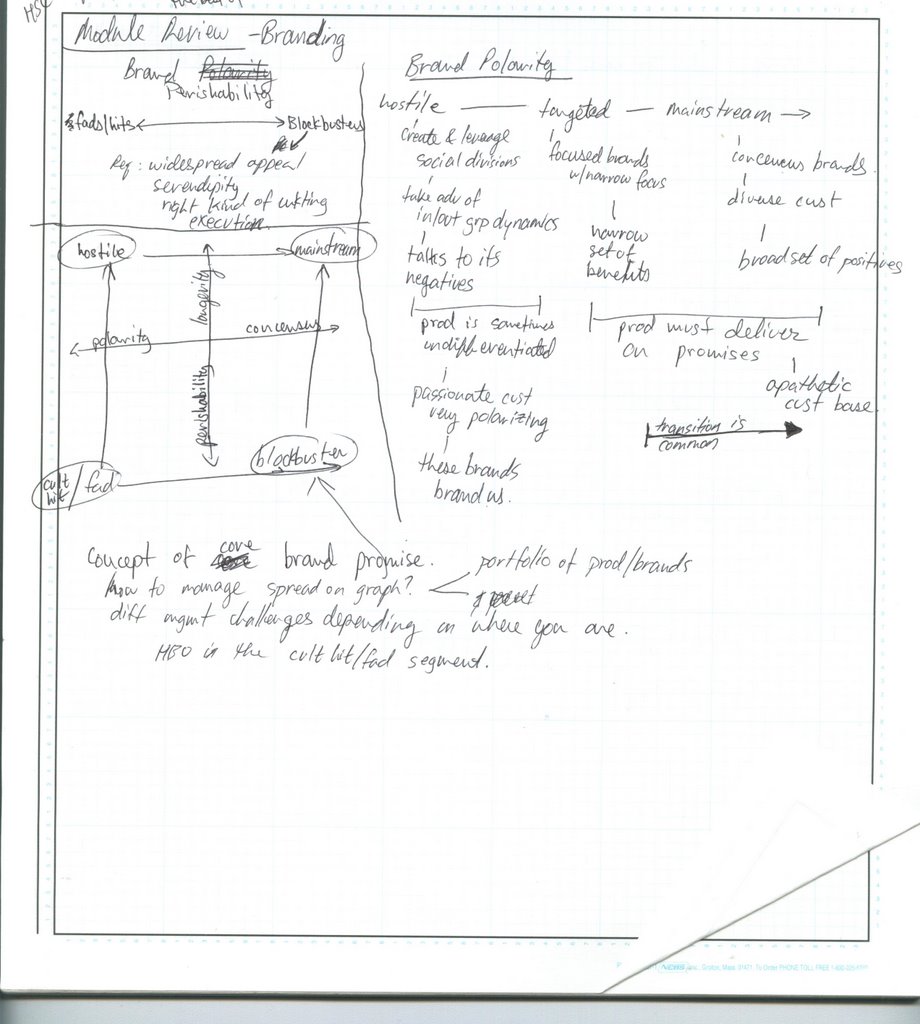
During the branding review on Friday I had an insight into what is happening with several of the organizations I am involved with outside of school. One of these organizations is the Hindu Students Council (HSC). HSC is a nation wide organization (with chapters in over 80 universities) that focuses on trying to unite and educate Hindu students as they attempt to learn about themselves and understand their own identity in college.
One of the results of this branding is the fact that its member base is fairly apathetic to the causes it picks up. Very few people are willing to get up and be an activist. However, this is something that the leadership team struggles with on a regular basis. How do they motivate and get their members more involved while maintaining the friendly, non-hostile environment. While they don’t think about it this way, in essence, the problem is how to they get HSC to go from a mainstream brand (and apathetic membership) to a brand that has a very enthusiastic, activist member base (with energy similar to that of followers of hostile brands).
We normally think of branding as something that companies do with products and product portfolios. However, the concept is equally applicable to non-profit & social organizations. In this case the customers are really an organization’s members. By mapping these concepts onto this world, we gain a new way to analyze organizational problems and find solutions. For example, to make members less apathetic, we can change an organization’s branding to be less main-stream. This action, involves a trade-off however, reduced membership count, but increased number of active members instead of a larger membership count, but fewer number of active members.
There is a continuum between extreme hostility and mainstream. By understanding where the organization positions itself, it can explore where it can move. It might even be possible to move a little bit on the continuum without loosing any of the current members. In short, for an organization that hasn’t thought of itself in these terms, it is very important for it to understand where on the continuum it positions itself in order to understand what its options are. Also, by knowing where the organization is, the leadership team can predict what will happen based on actions that move the group along that continuum.

Subscribe to:
Posts (Atom)